

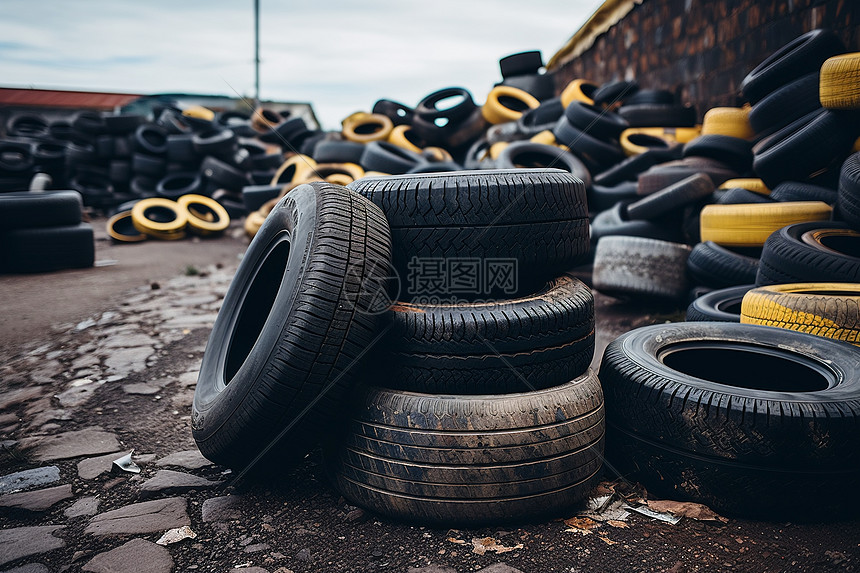
Scrapped tires pollute the environment, but by processing them into rubber powder, they can be recycled and reused.
1. Rubber powder can be processed through a desulfurization process into reclaimed rubber sheets, which are used to manufacture various mats such as machine mats, roadbed mats, and cushioning mats, as well as low-grade products with low mechanical performance requirements, such as mudguards and sound-absorbing materials.
2. Colored elastic floor tiles are used for constructing plastic sports fields, running tracks, and artificial turf. Rubber powder and rubber granules made from recycled and disinfected old rubber are pressed into a double-layer structure, with the bottom layer as the base and the surface layer colored, creating distinct yet integrated layers. They are both functional and decorative. **Features** include: non-slip, shock absorption, wear resistance, anti-static, sound absorption, sound insulation, moisture-proof, frost-proof, heat insulation, non-reflective, water-resistant, fireproof, non-toxic, non-radioactive, strong weather resistance, anti-aging, long lifespan, easy to clean, and easy to install.
3. Production of waterproof materials such as waterproof membranes, waterproof coatings, and waterproof sealants: Special rubber powder for waterproof membranes mixed with asphalt, resins, and other raw materials produces waterproof membranes with excellent aging resistance and good mechanical properties. In recent years, 40-80 mesh fine rubber powder has been widely used in the manufacture of waterproof membranes, significantly improving their quality and performance.
4. Road paving materials: Rubber asphalt has entered practical use for high-grade highways and airport runways in developed countries and is being widely promoted and rapidly developed in multiple provinces in China. Because the rubber powder contains antioxidants, it can significantly slow down road surface aging, giving roads elasticity and reducing noise. The road's wear resistance, water stripping resistance, and lifespan are 2-3 times that of ordinary roads, lowering maintenance costs, shortening vehicle braking distances by 25%, and improving safety.
5. Used for modified asphalt: Fine rubber powder and modifiers are mixed with asphalt to produce modified asphalt. High-grade highway joint filler: Special rubber powder mixed with asphalt, asphalt oil, filler, and cementitious agents shows good adhesion whether dry-mixed or wet-mixed. The filled joints have greatly improved filling capacity, water resistance, and peel resistance, and winter tear resistance and summer softening resistance increase by 40%.
6. Used for modified plastics: When added to plastic in certain proportions and mixed, it can be directly extruded. Experiments show that the modified plastic mixing and extrusion process performance is improved; the product's applicability is greatly enhanced. It is widely used in the footwear industry. Experiments show that after adding rubber powder, the comprehensive physical performance of shoe soles is close to that of material without rubber powder; mixing and extrusion process performance is improved; raw material costs are reduced; and the finished shoe soles meet national standard requirements in relevant performance tests.
7. Used for oilfield plugging and wall reinforcement: In practical applications, it combines well with other adhesive and aggregate raw materials.
8. Added to railway tracks: When added in certain proportions before prefabricated concrete mixing, it is directly cast into shape. Currently, it is used to manufacture railway tracks, isolation walls in special cases, special base structures, etc.


